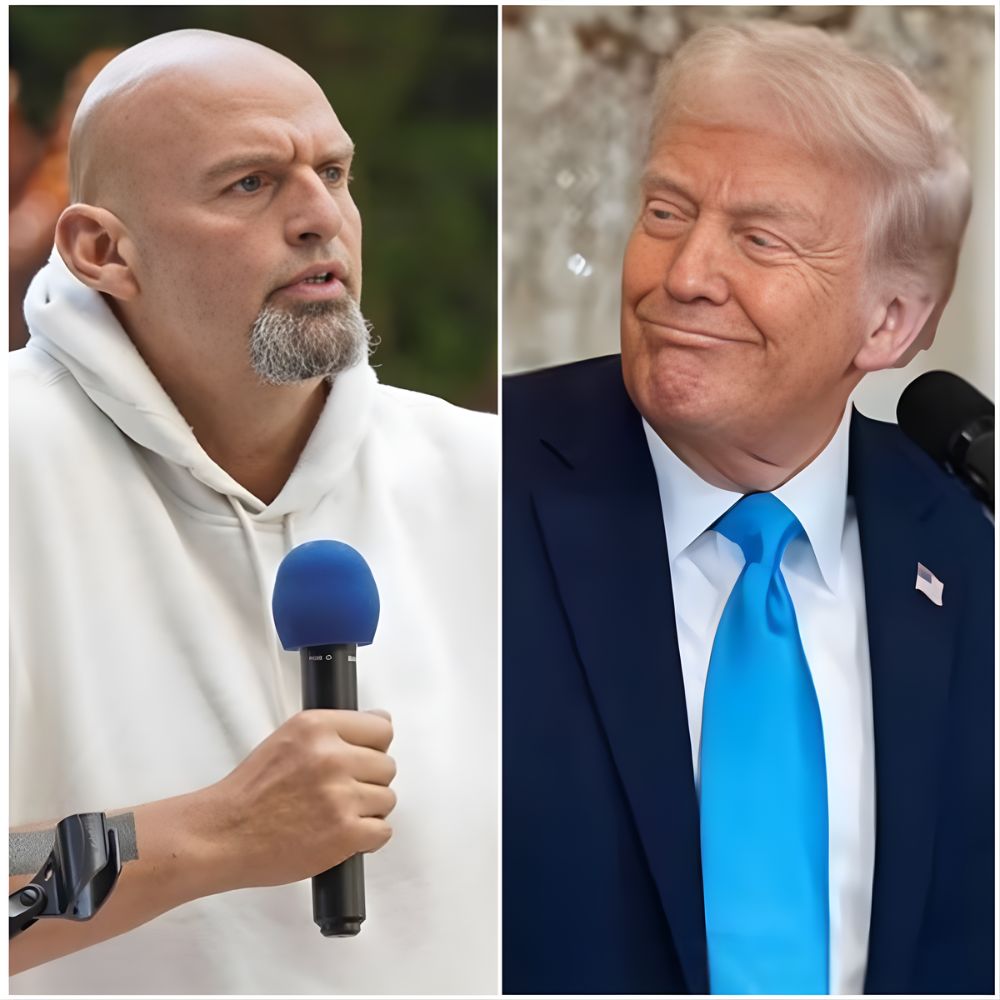
The camera flickered to life, capturing the imposing figure of John Fetterman as he leaned forward in his seat. His usual calm demeanor contrasted sharply with the words that began to slip from his lips. The studio, usually filled with chatter, quieted as his voice reverberated across the room. There was no mistaking the weight of the words he was about to deliver, nor the purpose behind them. In a world where political discussions often become battlegrounds of emotion, Fetterman chose a path of reason. He wasn’t just speaking; he was delivering a message—one that was as urgent as it was necessary
“Are you really not seeing what’s happening, or are you just pretending not to?” His voice, though measured, held a weight that immediately commanded attention. It wasn’t an accusation, nor was it an invitation for argument. It was a challenge, a question aimed not just at the panel before him but at the audience beyond the cameras. His eyes locked with theirs as he continued. The studio’s energy shifted as Fetterman’s calm determination became palpable. This was no longer a debate—it was a confrontation with the status quo.
He paused briefly, allowing the question to sink in. The silence hung heavy. No one spoke. No one even dared to interrupt. It was rare for a political figure to hold the floor so effortlessly, to cut through the usual noise with such simple, yet potent clarity. But Fetterman had this ability. And on this particular evening, he wasn’t about to let the conversation wander into familiar, safe territory. His next words would steer it into a space few were ready to navigate.
Chaos or Strategy?
Fetterman’s next line drew a stark contrast to the usual rhetoric. “Let me be clear,” he began, his voice still calm but now tinged with unmistakable resolve. He was laying down a marker, signaling that his statement was not just an opinion—it was a call to action. “This chaos you keep talking about isn’t spontaneous. It’s being amplified. Weaponized. Used for political gain.”
There it was. The accusation that no one had been brave enough to make until now: that the chaos in America wasn’t some unfortunate accident of circumstance. It wasn’t the product of a broken system, a collection of individual failings, or the inevitable result of political unrest. No, Fetterman was asserting that it was being deliberately stoked, played as a pawn in the hands of the powerful. His words felt like a shockwave, reverberating far beyond the confines of the television set, causing even those in the studio to reassess their own positions.
Before anyone could respond, Fetterman raised a hand—an unspoken command for silence. And for once, there was no pushback, no quip from the panelists, no attempt to reclaim the stage. He had taken control, and no one was willing to interrupt him.
“No—look at the facts,” Fetterman continued, his voice unyielding. His statement wasn’t just a political jab; it was a challenge to everyone watching to dig deeper, to confront the uncomfortable truths that had been buried beneath the noise. “When streets are allowed to spiral out of control, when police are restrained, when the rule of law is weakened, ask yourself one question: who benefits?”
The Unseen Hand
As Fetterman let his question linger, the gravity of it hit the room. His words were not just about a political party or a single moment in time. They were about the very fabric of American society. Who truly benefited from lawlessness? Who stood to gain from the weakening of institutions that had long been the bedrock of a functioning democracy?
For Fetterman, the answer was clear—and it wasn’t Donald Trump. His words fell with the weight of conviction: “Not Donald Trump.”
This wasn’t the typical narrative spun by mainstream media. This wasn’t the usual portrayal of Trump as the villain in a polarized narrative. Instead, Fetterman had taken a step back and dared to ask the question that few were willing to address: what if the chaos, the division, the fear being spread across the country wasn’t simply the product of Trump’s actions but the result of something much deeper, much more deliberate?
Fetterman’s assertion was uncomfortable. It was designed to be. His message was not for the faint of heart or for those looking to affirm their existing biases. It was for the thinkers, the ones willing to look beyond the immediate spectacle and examine the forces at play behind the curtains of political theater.
An Authority Beyond Politics
As the debate raged on, Fetterman’s voice cut through the noise with chilling clarity: “This disorder is being used to scare Americans. To convince them the country is broken beyond repair. And then—conveniently—to blame the one man who keeps saying the same thing: law and order matter.”
His words rang true in the most unsettling way. They struck at the heart of the political circus that had unfolded over the past few years. The manipulation of fear, the deliberate chaos—none of it was organic. It was orchestrated, played for maximum effect. And in the middle of it all stood Donald Trump, a man accused of being everything from a dictator to a demagogue. Yet, in Fetterman’s eyes, Trump wasn’t the architect of the destruction. He was the scapegoat.
Fetterman’s quiet confidence as he made this claim left no room for doubt. He wasn’t just speaking about Trump. He was speaking about the broader societal forces at play, the powerful institutions that found it easier to push a narrative of disorder than to confront the truth. He was calling out those who were willing to use the instability for political leverage, those who stood to gain from a fractured America.
The studio remained silent, absorbing the weight of what Fetterman had just said. It wasn’t just political discourse anymore; it was a diagnosis of the cultural and political illness eating away at the heart of the nation.

The Difference Between Order and Authoritarianism
The tension in the room escalated as a panelist muttered a challenge: “That sounds authoritarian.” It was a familiar refrain, one often used to dismiss calls for stronger measures in times of unrest. But Fetterman wasn’t having it. With a calmness that belied the seriousness of his response, he turned to the camera, his voice cutting through the air like a sharpened blade.
“No,” he said, emphasizing the word with quiet certainty. “Enforcing the law is not authoritarian. Securing borders is not authoritarian. Protecting citizens from violence is not the end of democracy—it’s the foundation of it.”
There was no room for misinterpretation in his words. Fetterman wasn’t advocating for tyranny. He wasn’t suggesting that the government should wield power unchecked. Instead, he was defending the very essence of democracy—the rule of law. In his view, the breakdown of law and order wasn’t just a consequence of chaos; it was the death knell of a functioning democracy. Without the rule of law, without the mechanisms that ensure safety and justice, America’s democratic ideals would erode.
Fetterman’s response was direct, but it was also a warning. It wasn’t a call for an iron-fisted state. It was a call for a return to the basic principles that had once made America great. It was a reminder that in the face of rising disorder, the true test of leadership was not in appeasing the voices of fear but in restoring balance, in reasserting control where it had been lost.
The Battle for Truth
As Fetterman continued, his words gained an almost prophetic weight. “The real game here,” he said, his voice sharpening, “is convincing Americans that demanding order is dangerous, while celebrating chaos as progress.” It was a rhetorical masterstroke—an insight into the very heart of the political struggle America faced in that moment. The battle, Fetterman suggested, was not about policies or ideologies. It was about perception.
The left and the right, the elites and the masses—all were caught in a tug-of-war over what America’s future would look like. Would the country continue to spiral into chaos, embracing a new narrative that celebrated anarchy as the price of freedom? Or would it recognize that true freedom could only be secured through order, through a return to the values that had sustained the nation for centuries?
Fetterman’s words were a call to action, a reminder that the stakes were higher than ever. The country’s future wasn’t just being decided in courtrooms or congresses—it was being determined in the hearts and minds of every citizen. The question was whether they would choose fear or faith, disorder or order.