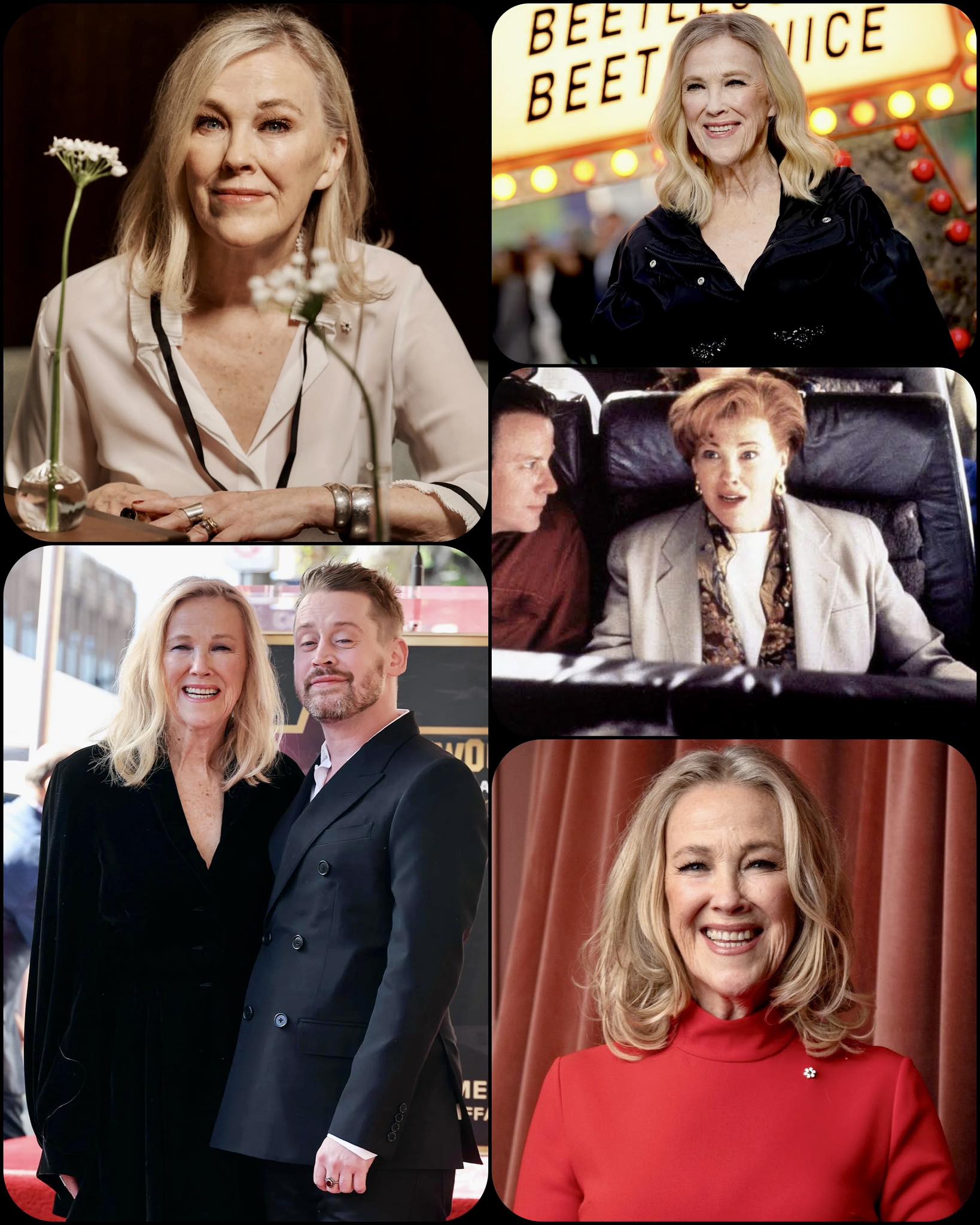
Beloved Canadian-American film and television actress, comedian, and screenwriter Catherine O’Hara has died at the age of 71.
With a career spanning more than 50 years, O’Hara brought endless joy and entertainment to audiences around the world while achieving extraordinary personal success. Over the course of her extensive career, she was nominated for more than 100 awards and won 35 of them.

Catherine O’Hara was born on March 4, 1954, in Toronto, Ontario, Canada. She began her career in her hometown in 1974 as a cast member of The Second City, an improvisational comedy theater group with programs based in Chicago, Toronto, and New York City. Two years later, The Second City created the sketch-comedy television series Second City Television (SCTV). O’Hara was a regular cast member during seasons one, two, and four, appeared as a guest during seasons five and six, and served as a writer during seasons one, two, four, and six.
During the seasons in which she was not a regular cast member, O’Hara appeared on other comedy programs and provided voice work for several animated children’s shows and television specials.
O’Hara was one of many major stars to emerge from SCTV. The cast included John Candy, Eugene Levy, Andrea Martin, Rick Moranis, Harold Ramis, Tony Rosato, and Martin Short, all of whom became famous names in their own right. O’Hara’s dual role as both a writer and performer helped earn her widespread recognition in Canada and led to her first Emmy Award win in 1982 for Outstanding Writing.
Following the end of SCTV in 1984, O’Hara continued working steadily in film and television. She appeared in a supporting role in Martin Scorsese’s 1985 neo-noir comedy After Hours. Her international breakthrough, however, came in 1988 with Tim Burton’s Beetlejuice.

Beetlejuice, a gothic horror comedy, featured an ensemble cast including Michael Keaton, Alec Baldwin, Geena Davis, Jeffrey Jones, Winona Ryder, and Catherine O’Hara. O’Hara portrayed Delia Deetz, an artist and the stepmother of Ryder’s character, Lydia Deetz. The film was a commercial success, grossing $75.1 million worldwide against a $15 million budget.
In 1990, O’Hara starred as Kate McCallister in the Christmas comedy Home Alone, directed by Chris Columbus and written and produced by John Hughes. The film launched Macaulay Culkin to stardom and earned $476.7 million worldwide, far surpassing its $18 million budget. It remains one of the highest-grossing comedy films of all time. O’Hara reprised her role as Kate McCallister in the 1992 sequel, Home Alone 2: Lost in New York.
Throughout the remainder of the 1990s and well into the 2000s, O’Hara appeared in numerous films and television shows. She became especially well-known for her voice work in animated films, including Sally in The Nightmare Before Christmas (1993), Tina in Chicken Little (2005), Penny in Over the Hedge (2006), Mrs. Walters in Monster House (2006), and Susan Frankenstein, among other roles, in Frankenweenie (2012).

In 2015, O’Hara experienced a major career resurgence with the Canadian sitcom Schitt’s Creek (stylized as Schitt$ Creek). The series aired from 2015 to 2020 and followed the wealthy Rose family after they lose their fortune when they are defrauded by their business manager. The family — video store corporation owner Johnny Rose (Eugene Levy), eccentric former soap opera actress Moira Rose (Catherine O’Hara) and their spoiled, self-centered children David Rose (Dan Levy) and Alexis Rose (Annie Murphy) — are forced to relocate to their only remaining asset, which is a small, desolate town called Schitt’s Creek which Johnny purchased as a joke decades earlier.
The series reunited SCTV alumni Eugene Levy and Catherine O’Hara, a collaboration that proved highly successful. O’Hara won an Emmy Award and a Golden Globe in 2020 for Best Lead Actress in a Comedy for her performance as Moira Rose. She also won Best Actress in a Continuing Leading Comedic Role at the Canadian Screen Awards for six consecutive years, from 2016 to 2021.
Both Variety and Deadline report that O’Hara died at her Los Angeles home after a brief illness, according to her agency, Creative Artists Agency (CAA).
Following the news of her death, tributes poured in from stars and collaborators who worked closely with O’Hara. “Mama. I thought we had time. I wanted more. I wanted to sit in a chair next to you. I heard you. But I had so much more to say. I love you. I’ll see you later.”


Seth Rogen also shared a tribute on Instagram, writing: “Really don’t know what to say… I told O’Hara when I first met her I thought she was the funniest person I’d ever had the pleasure of watching on screen. Home Alone was the movie that made me want to make movies. Getting to work with her was a true honour. She was hysterical, kind, intuitive, generous… she made me want to make our show good enough to be worthy of her presence in it. This is just devastating. We’re all lucky we got to live in a world with her in it.”

Director Martin Scorsese told IndieWire: “To lose Catherine O’Hara… it feels impossible to me, and to millions of others as well, I’m sure. Many people know her from ‘Schitt’s Creek.’ For many others, it’s the ‘Home Alone’ pictures or ‘Beetlejuice’ or the Christopher Guest comedies. For me, and for most of my friends, it’s ‘SCTV’: all I have to do is think about one of the characters she created, like Lola Heatherton or Dusty Towne, and I’m laughing. Catherine was a true comic genius, a true artist, and a wonderful human being. I was blessed to be able to work with her on ‘After Hours,’ and I’m going to miss her presence and her artistry. We all are.”
O’Hara is survived by her husband, production designer Bo Welch, whom she met on the set of Beetlejuice, and their two sons, Matthew and Luke.
Listen to the ‘Eye On Horror Podcast’

Scream has been showing up for decades and it somehow refuses to age. The franchise understands that fear alone cannot carry a movie for very long. Timing matters just as much as blood and screams. The laughs keep the audience relaxed just enough to make the next scare land harder.
What Scream understands better than most is that horror is both terrifying and deeply silly. People panic and ignore common sense while answering phones they should never answer. Someone always opens the door they should not open. The humor slides into the chaos without stopping the story which keeps everything moving forward.
Meta Makes The Genre Smarter

Scream talks directly to the audience without sounding smug or superior. The characters know horror movies exist, and they know the rules, but they still mess up constantly. That awareness makes them feel human instead of clever cutouts. You laugh at their mistakes, and then you tense up because you know better choices will not save them.
Meta humor can feel lazy when it replaces tension, but Scream uses it to sharpen the blade. Calling out tropes only makes the moments that break them more effective. You think you are safe because you recognize the setup. Then the film reminds you that recognition does not equal control.
Villains With Personality

Ghostface works because he is more than a mask and a knife. He has patience and an unsettling sense of humor. His voice can be playful one second and threatening the next. That unpredictability makes every phone call feel dangerous.
Each encounter feels like a performance where the killer enjoys the spotlight. Ghostface mocks his victims and toys with expectations. The franchise allows the character to evolve without losing that dark comedic edge. A villain who can scare you and amuse you at the same time is hard to forget.
The Laughs Keep The Fear Alive

Without humor, Scream would blend into the slasher crowd. The jokes give the audience a moment to breathe before the tension tightens again. That rhythm keeps the experience fun without ever feeling safe. You never relax for long and that is the point.
Laughing does not weaken the horror in Scream. It makes the scares feel sharper and closer. The film lets you enjoy yourself right before reminding you that anyone can die. Surviving the joke becomes part of surviving the night.
Why It Keeps Coming Back

Scream could have collapsed under its own legacy years ago. Instead, it keeps adjusting its tone and updating its targets. The franchise respects its audience enough to change without explaining itself to death. That trust keeps people coming back.
There is confidence in a series that can laugh at itself and still draw blood. Scream understands that horror works best when it balances wit and cruelty. It keeps surviving because it knows when to smile. And then it knows exactly when to strike.
Listen to the ‘Eye On Horror Podcast’

The Purge arrived with one of the cleanest horror concepts ever sold. One night a year all crime becomes legal. That single idea did all the heavy lifting. You could feel the dread without needing a single chart.
The early film worked because it stayed small. A house a family and one terrible night. The rules were simple enough to understand and cruel enough to scare. The film trusted the audience to connect the dots. That restraint made the premise feel dangerous.
Then The Purge Decided To Explain Itself

Success told the franchise to think bigger. Suddenly The Purge needed history, politics, and a mission statement. Sequels rushed to explain who approved it and why it existed. The mystery evaporated fast.
Once everything had a reason the fear softened. The Purge became a system instead of a threat. Instead of imagining horrors we were given explanations. Nothing kills tension faster than being walked through it step by step.
World Building Ate The Fear

The Purge wanted to be about everything. Class warfare, government corruption, and social engineering took center stage. Those ideas are interesting, but they crowded out the horror. The films started talking more than they scared.
Lore piled up without adding atmosphere. New rules showed up every movie. Exemptions and timelines kept multiplying. The night stopped feeling chaotic and started feeling regulated which is deeply funny for a franchise about lawless violence.
When The Monster Becomes Policy

The scariest version of The Purge was the one you barely understood. Once it became a policy discussion the teeth dulled. Fear needs uncertainty to survive. When you know how the machine works it stops feeling alive.
Characters also suffered from this clarity. People became mouthpieces instead of humans. Speeches replaced panic. The franchise forgot that terror lives in reactions not explanations.
Why The Original Still Matters

The first Purge film remains effective because it knew when to shut up. It used the concept as a spark not a thesis. The horror came from watching ordinary people face impossible choices. You never needed a rulebook to feel it.
The Purge franchise did not fail because the idea was weak. It stumbled because it kept explaining the nightmare instead of letting it breathe. Sometimes the scariest thing is not knowing how bad it can get. The Purge taught us that one great night was enough and everything after that just talked it to death.

Do you remember when Saw was an acclaimed think piece that tested the limits of what people would do to survive instead of a gore gimmick? James Wan and Leigh Whannell do. Which makes sense when you consider that these two created the franchise that ultimately made them horror legends.
Wan recently sat down with Letterbox while attending the Sundance Film Festival. When asked about his feelings on returning to the Saw franchise, Wan had much to say about his career starter.
“For me to finally come back to it, I feel I have probably the freshest outlook. I feel I can come back to it with a new perspective whilst knowing that with this next movie I want to hark back to the spirit of the first movie,” says Wan.
“One of the things I really want to do with this next Saw is make it scary again. I want to make a scary Saw — not just gory, but psychologically scarring, like what Leigh and I did in the first movie.
“Leigh and I both want to recapture the spirit of that first film and revisit Jigsaw’s philosophy, which is that he goes after people who don’t appreciate their lives.”

Wan continues, “If you’re a scumbag, but you appreciate your life, he doesn’t see you as someone who’s wasting your life, so I want to go back to what we touched on in the first movie with regard to that.
“At the same time, I want to honor what people have come to love about the franchise, whilst trying to do something fresh and new that we haven’t seen before.”
“This next movie would be the eleventh installment, and there’ve been lots of films in this world. We need to do something different in order to reach out to a new generation that didn’t grow up with it.”
If you can’t trust the series creator, who can you trust?