Spot-the-difference games, visual puzzles, and optical illusions have a way of completely absorbing our attention. They seem simple enough to solve instantly, yet tricky enough to make you question your eyes, your brain, and even your sanity. I’ve always loved them—the small thrill when the hidden object finally appears feels like a tiny personal victory. So when this challenge started making the rounds online, I couldn’t resist trying it. People everywhere claimed it was impossible: a hidden dog, camouflaged so perfectly that comment sections overflowed with confusion, frustration, and occasional meltdown.
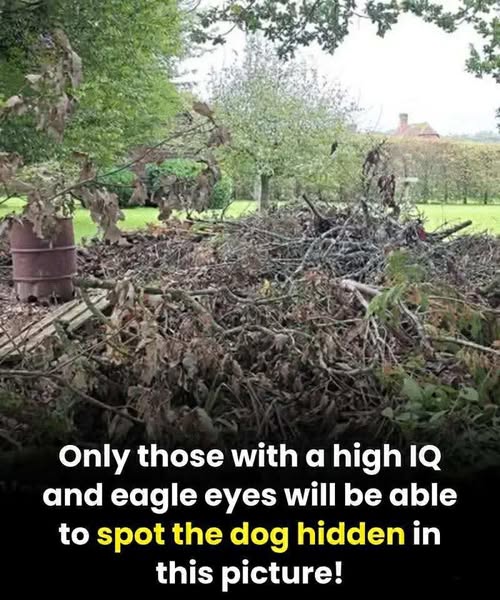
At first glance, the photo looks ordinary: a jumble of brown twigs, dry leaves, and brittle branches filling the frame. No bright colors. No obvious movement. Nothing that shouts, “There’s a dog here!” It’s the kind of picture you scroll past dozens of times without noticing. And that’s why it works. Somewhere in that chaos is a small spaniel, blending seamlessly as if nature itself painted him into the scene.
The image first appeared on Reddit with the caption “FindTheSniper” and quickly became an obsession. People squinted at screens, increased brightness, tilted phones at odd angles, convinced it was a prank. One user wrote, “I stared so long I started questioning my own existence.” Another said, “Even after someone posted the answer, I STILL couldn’t see it. My brain just gave up.”
It makes sense. Our brains don’t process every pixel. We jump to conclusions, search for predictable shapes, and fill in what we expect to see. We’re wired to spot contrast, movement, and familiar outlines. When all these cues vanish into a mass of similarly colored branches, the brain stops trying. The dog remains invisible—until suddenly it’s not.
That moment of recognition is shocking. One second you think it’s a joke, the next your eyes land on something that’s been there the whole time: a curve of fur, a glint of eyes, a small ear blending into the brush. It’s humbling and amazing—a reminder that seeing isn’t the same as noticing.
The dog is small, sitting perfectly still, its fur matching the surrounding brush. Start in the center and move your gaze left, and you’ll eventually spot a faint shape that isn’t a branch. Then the outline forms. Then the eyes. In an instant, the dog snaps into focus, as if it had always been obvious.
Online reactions ranged from triumphant to disbelieving. Some celebrated like they’d solved a national mystery. Others admitted defeat. A few even said they now suspiciously examine every leaf in their yard. The photo became an accidental lesson in human perception—how our expectations shape what we see and what we miss.