PART 2 — THE MOMENT THE LAUGHTER DISAPPEARED
The orchestra thundered through the theater, its powerful melody filling every corner of the auditorium.
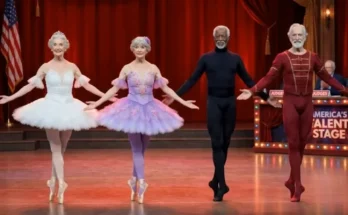
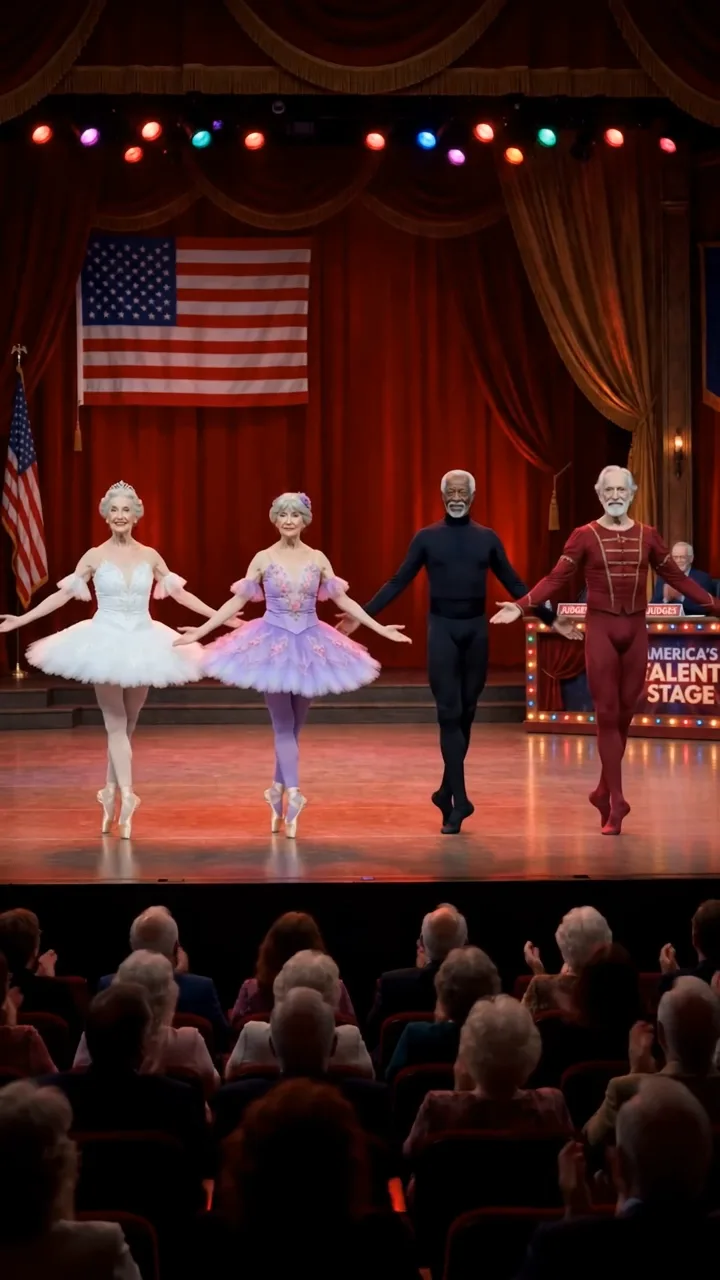
Beneath the American flag, the four elderly dancers held their opening formation for one final beat.
Then the two ballerinas moved.
Their arms unfolded in perfect synchronization, tracing elegant arcs through the light. Both women maintained their balance on pointe as they glided across the polished stage, their movements delicate but astonishingly controlled.
Beside them, the two elderly men stepped forward in unison.
Their silver-white hair caught the spotlight as they extended their arms, turned their bodies, and moved into a sequence of precise classical ballet positions. Their strong frames remained upright, their transitions smooth and effortless.
The audience’s expressions began to change.
One young dancer backstage stopped laughing.
Another lowered her hands from her mouth and leaned forward, her eyes fixed on the stage.
At the judges’ table, the female judge slowly loosened her crossed arms. The bespectacled male judge lowered his microphone, watching the quartet with growing concentration.
The performance accelerated with the music.
The two ballerinas traveled through a series of controlled turns, their pointe shoes striking the stage with barely audible precision. The two men moved around them in a carefully coordinated pattern, extending their arms to frame the women without disrupting the formation.
Every movement connected to the next.
Every turn landed exactly where it was meant to.
There was no hesitation, no confusion, and no visible struggle to keep pace with the orchestra.
The four dancers moved as though they had spent a lifetime learning to breathe with the same rhythm.
Because they had.
The audience no longer saw four elderly people attempting something beyond their abilities.
They saw four performers who understood the stage, the music, and the language of ballet with extraordinary depth.
The orchestra rose toward a dramatic passage.
The ballerinas extended their arms while the two men stepped into position beside them. The quartet rotated into a new formation, their timing so precise that their movements appeared almost mirrored.
A spectator near the front slowly lowered his phone.
He didn’t want to miss a second.
The female judge leaned toward the stage, her earlier expression of doubt replaced by intense attention.
Mr. Harrison remained silent.
Then the four dancers began their next sequence.
The women rose onto pointe once more, while the men executed a series of powerful, controlled turns. The quartet crossed paths without colliding, each dancer arriving at the exact position required by the choreography.
The audience watched in complete concentration.
The laughter was gone.
The whispers were gone.
Only the orchestra and the sound of four pairs of feet moving across the stage remained.
As the music approached its climax, the dancers drew closer together.
Their arms rose.
Their bodies aligned.